
- Written by: Elaah
- 18 de July de 2026
Stage I Breast Cancer: Early Detection and Survival Rates
In recent years, breast cancer awareness has gained more prominence, yet many people still do not know what it is really about. According to the National Cancer Institute (NCI), breast cancer occurs when the breast cells grow abnormally, creating a tumor that may spread to other areas in the body (2025). Despite being a very harmful disease, there are diagnostic methods and treatments that help fight cancer and could cure it if detected early. In fact, stage I breast cancer has a survival rate of over 90%, precisely because it is diagnosed early and there is information about how it proceeds during each stage.
How Breast Cancer Is Staged
When a patient is diagnosed with breast cancer, the doctor can provide a disease prognosis based on the stage it is at. The stages describe the degree of tumor progression and also help doctors to determine treatment. When tumor staging is performed, a number from 0 to IV (4) is given, which is defined by the TNM (tumor-node-metastasis) value, biomarkers (hormone receptors or HER2 receptors), and tumor grade (abnormality, growth and spread of cancerous cells) (NCI, 2026). A lower stage number indicates that the cancer is localized and has not spread; therefore, stage I is the most favorable since the tumor is small and localized, represents a higher survival rate, and has a lower risk of recurrence.
Survival Rates by Stage and Subtype
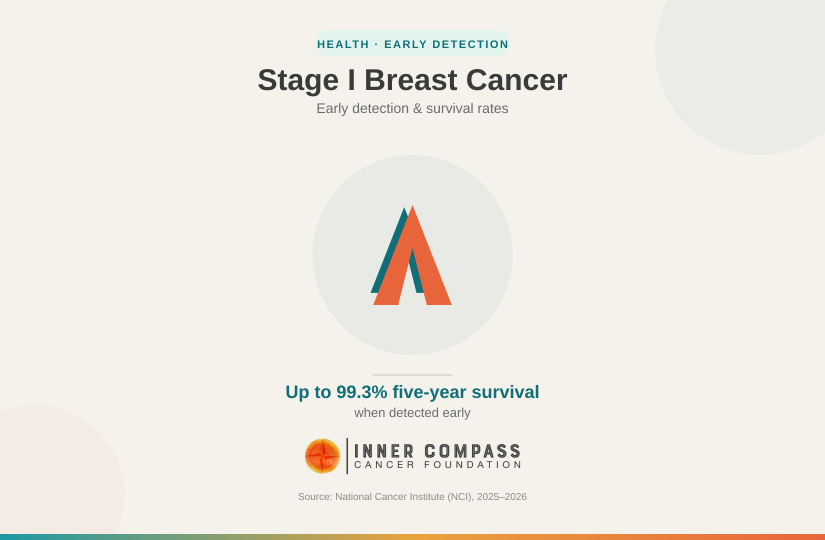
Breast cancer survival rates vary according to tumor type, molecular subtype, and stage; however, outcomes are highly favorable when the disease is timely detected. According to NCI statistics, the 5-year survival rate for localized breast cancer (generally corresponding to stage I) is 99.3%, and when classified by hormone receptor (HR) and HER2 biomarker status, survival rates go from 91.8% to 100%, depending on the molecular subtype (NCI, 2025). Hence, it remarks the importance of checkups and early detection of this disease.
Why Early Detection Matters
Breast cancer remains a significant health concern, but advances in diagnosis and treatment have improved outcomes for patients. Therefore, understanding how the disease is staged and recognizing the benefits of early detection are essential for reducing mortality and improving quality of life.
Sources
This article is based on statistics and staging information published by the National Cancer Institute (NCI).
- National Cancer Institute (NCI). (March 4, 2026). Understanding Breast Cancer Stages. https://www.cancer.gov/types/breast/stages
- National Cancer Institute (NCI). (December 2, 2025). What is Breast Cancer? https://www.cancer.gov/types/breast/what-is-breast-cancer
- National Cancer Institute (NCI). (December 2, 2025). Survival Rates and Prognosis. https://www.cancer.gov/types/breast/survival